
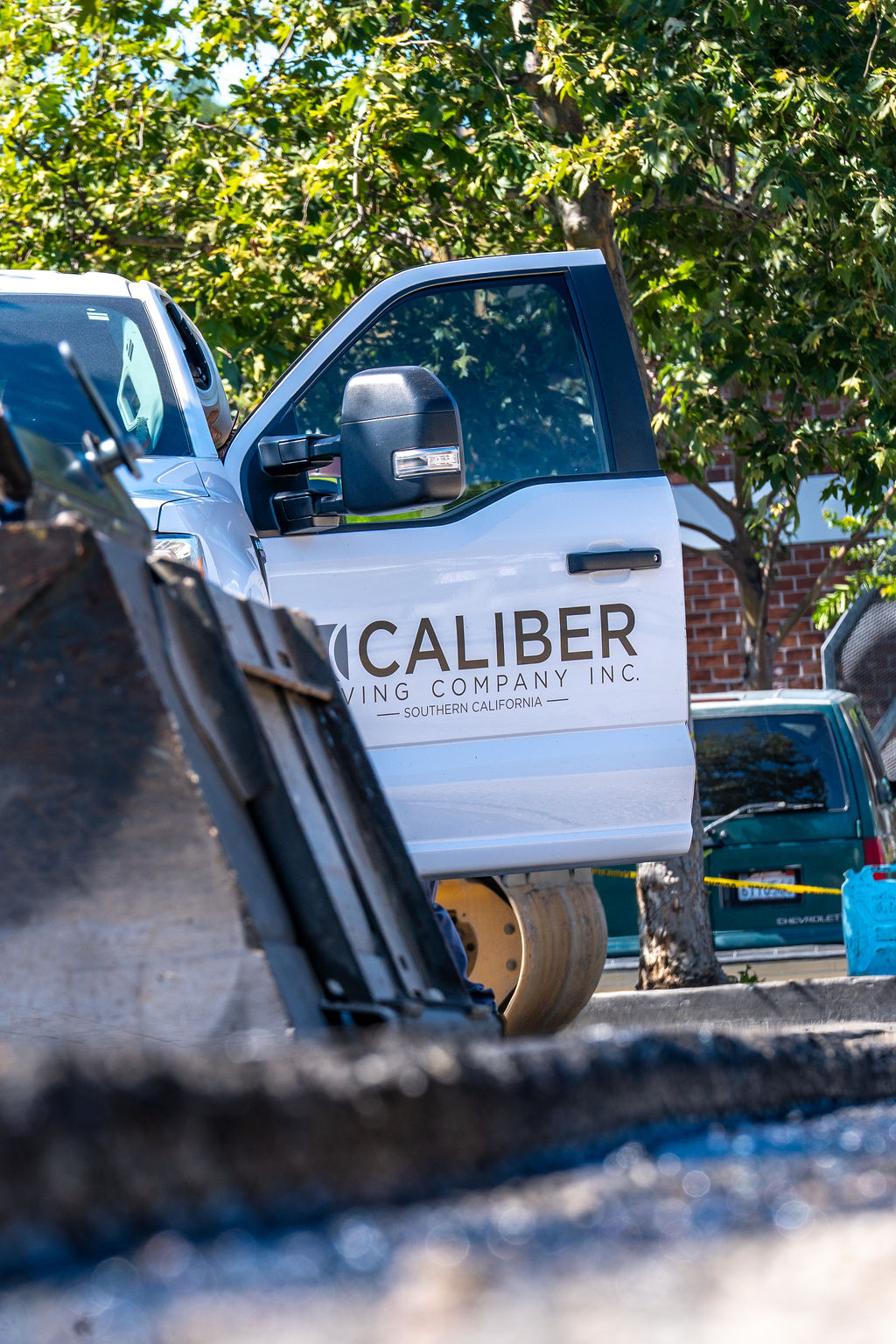
Potholes, cracking, sunken areas and failing patches are the visible end of a problem that usually starts underneath the surface. Caliber Paving repairs commercial asphalt across Orange County, Los Angeles, Riverside and San Bernardino, San Diego, Arizona and Las Vegas, with in-house crews and a proposal that tells you plainly what is wrong and what it will take to fix.
Most pavement does not need to be torn out. The right repair, done at the right time, costs a fraction of replacement and buys years of additional life. The wrong repair hides the problem until it comes back bigger. The section below explains how to tell which is which.
Asphalt repair services
A full range of repair work, from a single pothole to resurfacing an entire commercial lot.
Pothole Repair
Failed areas cut back to sound pavement, cleaned, tacked and filled with hot mix, then compacted flush with the surrounding surface so the patch does not become the next failure point.
Asphalt Patching
Surface and full-depth patching for localized damage. Full-depth patching removes the asphalt and the failed base beneath it, which is the only lasting fix where the base has given way.
Crack Filling & Sealing
Cracks routed and filled before water reaches the base. The single cheapest thing you can do to extend pavement life, and the one most often deferred until it is too late.
Resurfacing & Overlays
A new wearing course over a structurally sound base, restoring the surface and ride without the cost of full reconstruction. Includes Petromat fabric overlays where reflective cracking is a concern.
Grinding & Leveling
Milling high spots, feathering transitions at thresholds and gutters, and correcting the trip hazards that create liability exposure on a commercial property.
Drainage & Low-Spot Correction
Standing water is a pavement problem before it is a nuisance. We correct low spots and install or repair concrete flowlines and swales so water leaves the surface.
Which repair does your pavement need?
What you can see on the surface usually tells you what is happening underneath. This is the shorthand our estimators use.
| What you see | What it usually means | Typical fix |
|---|---|---|
| Thin, isolated cracks | Normal ageing and surface oxidation. The base is intact. | Crack filling, then seal coat |
| Interconnected, scaly cracking | Alligator cracking. The base has lost strength, almost always from water. | Full-depth removal and replacement of the failed area |
| Potholes | A localized base failure that has broken through the surface. | Cut-out and hot mix patch |
| Standing water a day after rain | A grade or drainage problem, not a surfacing problem. | Low-spot correction, flowline or drainage work |
| Rutting or depressions in drive lanes | Base compaction under repeated heavy loads. | Full-depth repair, sometimes with a thicker section |
| Faded, grey, brittle surface | UV oxidation. Structurally fine, losing its binder. | Seal coating, not repair |
| Raised edges, lifted slabs, uneven thresholds | Trip hazards and liability exposure. | Grinding, feathering or localized replacement |
If you are seeing more than two of these at once, the lot is likely past the point where spot repairs are economical and worth a condition assessment instead.
Repair or replace: how the decision gets made
The question is not how bad the surface looks. It is whether the base beneath it is still carrying load.
Repair makes sense when damage is confined to the surface layer, the base is sound, and the affected area is a manageable share of the lot. An overlay over a good base restores the surface at roughly half the cost of reconstruction and can add a decade of life.
Replacement makes sense when the base has failed across a large portion of the lot, when alligator cracking is widespread, or when repeated patches in the same locations keep failing. Patching a failed base is money spent twice.
Core sampling settles it. A core shows the asphalt thickness and the condition of the material beneath it, which is the difference between an informed recommendation and a guess. For the numbers behind each option, see our commercial paving cost guide.
Why property managers call Caliber
Where we repair asphalt
Commercial asphalt repair across the Southwest, from a single property to multi-site portfolios.
If you do not see your city, we very likely still serve it. Call (714) 556-0484 and we will tell you straight away.
Asphalt repair questions
What is the difference between asphalt repair and asphalt replacement?
Repair treats damage in the surface layer while leaving the existing base in place, using patching, crack filling or an overlay. Replacement removes the pavement and rebuilds the base beneath it. The deciding factor is whether the base is still sound. If the base has failed, repairs to the surface will fail again in the same spots.
How do I know if my parking lot needs repair or just seal coating?
Seal coating is a protective surface treatment and is not a repair. It will not fix cracks, potholes or depressions. Cracks should be filled and failed areas patched before any seal coat is applied. If you have potholes, alligator cracking or standing water, you need repair work first.
What is alligator cracking and can it be patched?
Alligator cracking is an interconnected pattern of cracks that resembles reptile skin. It signals that the base under the asphalt has lost its strength, usually from water intrusion. Surface patching over alligator cracking does not last. These areas normally require full-depth removal and replacement of both the asphalt and the affected base.
How long does commercial asphalt repair take?
Most patching and crack filling work on a commercial lot is completed in one to three days, and can often be phased or scheduled overnight so the property stays open. Larger resurfacing projects take longer and depend on lot size, weather and cure time.
How much does asphalt repair cost?
Cost depends on the type of repair, the area involved, the depth of the damage and access to the site. Crack filling and surface patching cost far less than an overlay, which in turn costs far less than full-depth reconstruction. Caliber Paving provides property-specific proposals and publishes a commercial paving cost guide covering the factors that affect pricing.
Do you repair asphalt in Los Angeles and Orange County?
Yes. Caliber Paving provides commercial asphalt repair across Orange County, Los Angeles, Riverside and San Bernardino counties, San Diego, Arizona and the Las Vegas area.